The Etruscans
Compared to other advanced ancient civilizations of the same era, such as Greek or Chinese, we know relatively little about the Etruscans who dominated central Italy for nearly half a millennium, from~800 to 300 BCE. Several factors contribute to this sorry state of affairs.
The Etruscan language is still a puzzle for modern linguists who can understand only a few hundred words. It has long been considered a language “isolate” and is not in the Indo-European family. Although early Roman authors refer to an extensive Etruscan literature, something that would help immensely in understanding the language, nothing readable remains. Various explanations have been advanced for this surprising absence: the intentional, systematic destruction of Etruscan literature by early Christians eager to stamp out “pagan superstition,” the fragility of the medium used to record writing, the natural extinction of a language not as widespread in the ancient world as, say, Greek. Probably all of these played a part.
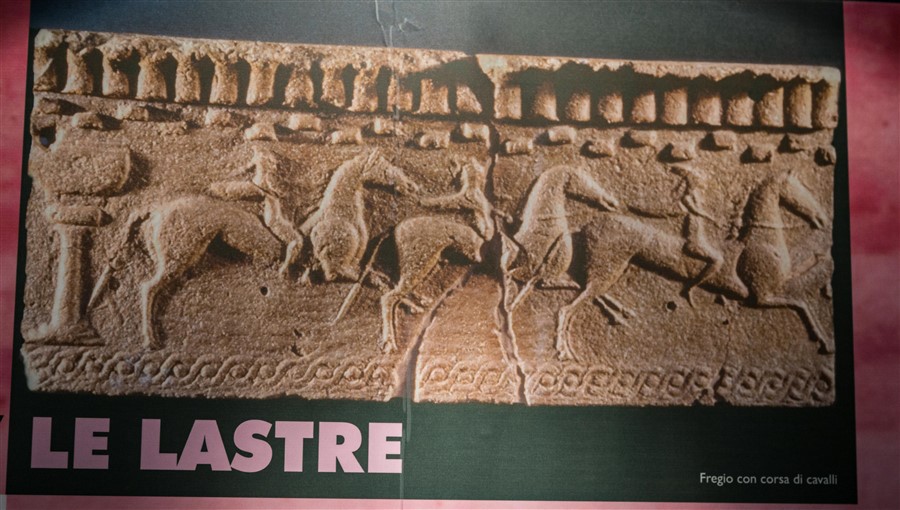
Decorative plaques depicting a bareback horse race reminiscent of today’s palio 
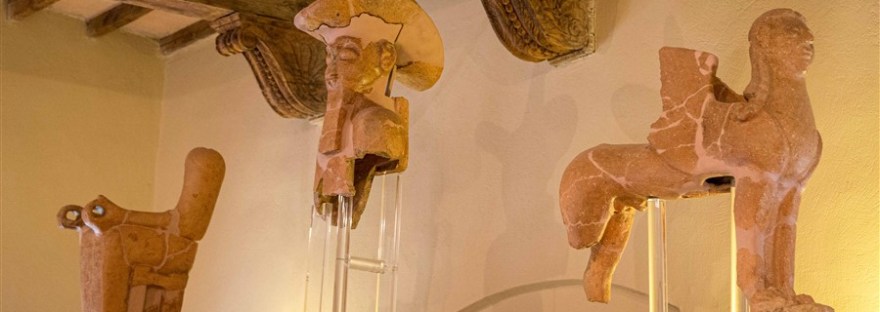
Terra Cotta decoration covered the wooden beams that supported building roofs 
The Etruscans loved horses and their images show up often in art and decorative motifs.
The Etruscans left no imposing temples or amphitheaters, no substantial remains from which we might reconstruct towns or buildings. Domestic structures were built of wood and plaster, materials that do not survive over centuries. Many Etruscan towns lie beneath those built over them in medieval and later times making excavation for archeological purposes impractical.
Finally, it seems clear that the Etruscan civilization was completely overshadowed – some say obliterated – by the conquering Romans who, nevertheless, took many of their ideas on art, road building, city planning, water management, law, religion, architecture, even clothing. Indeed the toga, the familiar outer garment of Roman citizens, was appropriated from the Etruscans. Contemporary bloggers and Tuscan travel sites have taken up the cause of this amazing civilization, hoping to set the record straight.
Despite these obstacles, we know enough about the Etruscans to merit the admiring descriptors I have used above. How? Most of what we know comes from contemporary Greek, Roman, Egyptian and Middle Eastern sources.They are not without their prejudices but give us enough information to create a sense of Etruscan society, its history, structure, and functioning.
In addition, while the Etruscans left no temples, above ground tombs, usually small stone buildings but sometimes very large round structures, have been found. These may be furnished and decorated with magnificent, vividly colored wall paintings which give us a glimpse into their daily lives and social attitudes.
More about the Etruscans later.
 Jconcetta's Journeys