On an Equal Footing in Siena
Piazza del Campo
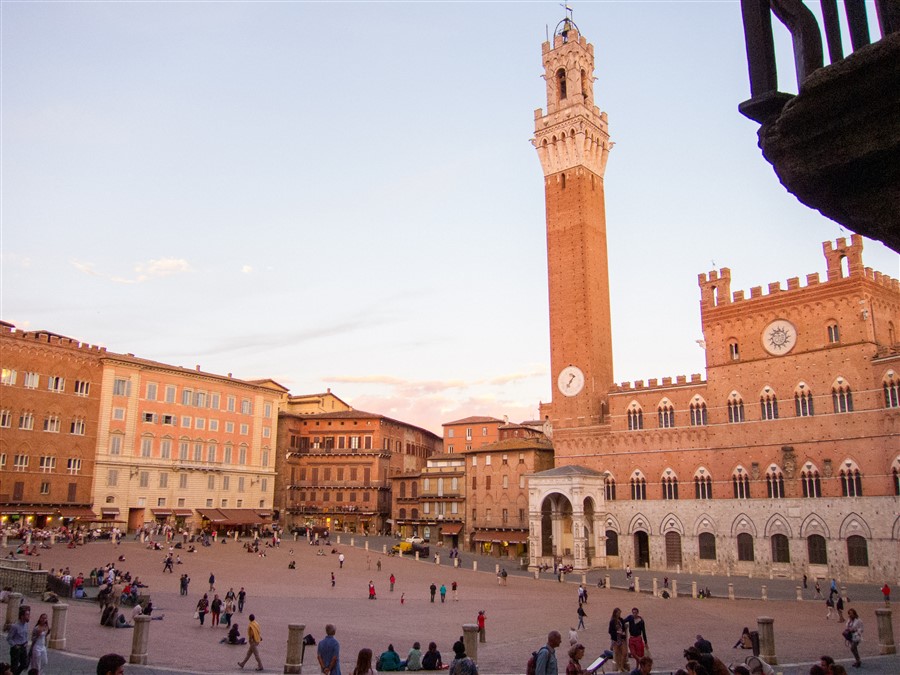
The Historic Center of Siena is a UNESCO World Heritage Site described as “the embodiment of a medieval city.” At its center is the public square, Piazza del Campo, widely regarded as one of the finest in Europe owing to its beauty and architectural integrity. It’s shaped like a scallop shell with the flat portion bordered with the Pallazo Pubblico, the historic seat of local government, and, rising from it, the magnificent Torre del Mangia,. The latter was built to match the height of the Duomo di Siena to signify that the church and the state were equal, having the same level of authority.
Siena was created when three communities that existed on three adjacent hills coalesced. At the intersection of the Y that delineated the roads to those communities and beyond, there was a valley that served as a convenient marketplace. This is the site of il Campo, as it is commonly called, meant to be a neutral territory for activities, games and political and civic holiday celebrations. Its present form was created in the mid-14th century with deliberate intention to establish harmony between the buildings and the square. The palatial homes of Siena’s ruling elite lining the square were required to have uniform roof lines in contrast to the earlier tower houses, symbols of community strife.
The Piazza was intended as an area where the entire population of the city could attend activities. The population of Siena in its golden era has been reported as between 50,000 and 80,000. Today, for the Palio, 28,000 people cram into the center and another 33,000 line the perimeter.
The red brick herringbone paving of the Piazza slopes slightly downward, inviting one to simply sit down as if at a beach or amphitheater, and that is exactly what people do. It is possible to climb the 400 steps up the Torre del Mangia but I did not attempt that even knowing spectacular views of the city and the countryside were in the offing. Below is an image, not mine, taken from the top of the tower, to give you a feel for the magnitude of this splendid town center.

Il Campo, viewed from the top of the Torre del Mangia
(Mark Sehnert, Public domain, via Wikimedia Commons)
Duomo di Siena
If you have been to Florence you will have been impressed by the immense cathedral, Santa Maria del Fiore, with its polychrome marble exterior and extraordinary dome. Siena’s cathedral, dedicated to Santa Maria Assunta, is not as large but boasts a most fascinating facade and an eye popping interior.
Compare the interiors of the two cathedrals, Siena’s on the left, Florence’s on the right.
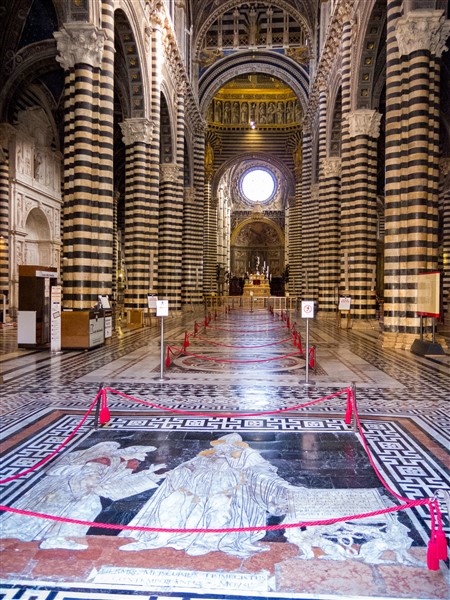
Interior, Siena Cathedral 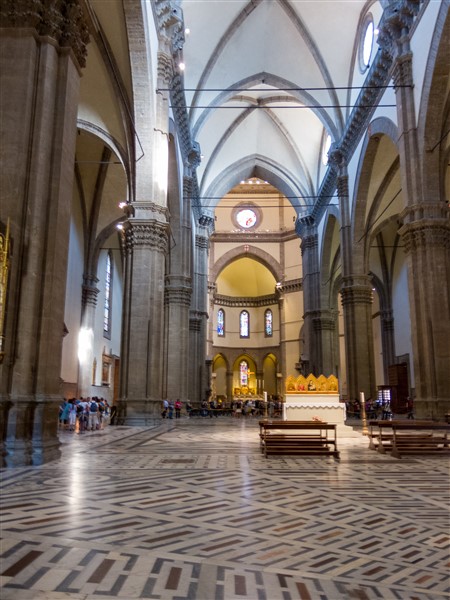
Interior, Florence Cathedral 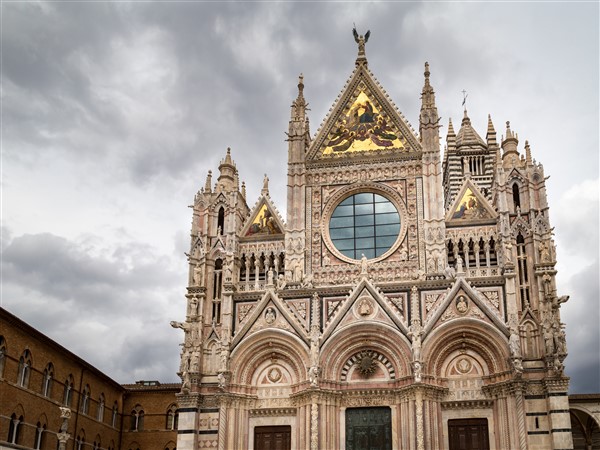
West Facade, Siena Cathedral 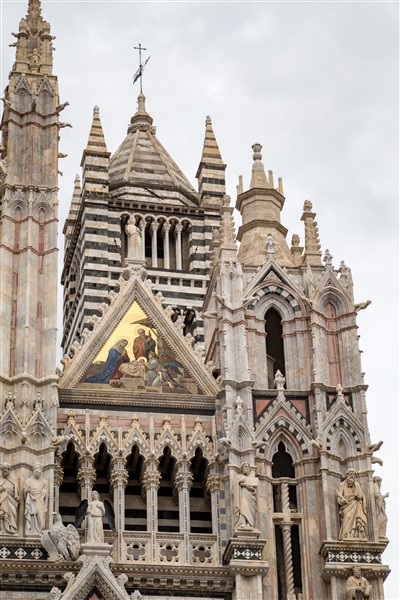
Upper facade with bell tower rising behind
The magnificent Duomo di Siena rises from a piazza atop one of the three hills above il Campo. Legend has it that it was built on the site of a 9th century Christian church which in turn had been built over a Roman temple dedicated to the goddess Minerva. Construction started in 1200; records show masses being held as early as 1215 and the main sections completed by 1264. Much of the exterior and the entire interior are sheathed with alternating layers of white and greenish-black marble. Black and white are the colors of the Siena coat of arms, arising from a foundation story that links the city to a noble and ancient ancestry.
Built in two stages, the lavish facade is a combination of French Gothic, Tuscan Romanesque and Classical architecture. The lower facade, (1284-1296) with its three portals is covered with sculptures of prophets, sibyls, mythical animals and gargoyles, the work of Giovanni Pisano. The upper facade, which was finally completed some 60 years after Pisano left Siena for Pisa, features heavy Gothic decoration.
The interior is a dazzling collection of sculpture, painting, stained glass, inlaid wood and mosaics. One hardly knows where to look first. I visited the Duomo on two occasions but could have spent the entire month exploring its treasures. For me the most impressive and beautiful of these treasures are the mosaics that completely cover the floor, 56 interlocking slabs covering 14,000 square feet, depicting scenes from Classical antiquity, the Old Testament, allegories, all of which meant to send a message of salvation and wisdom to the viewer. It is now possible to climb above the vaults for extraordinary views of the interior and exterior. Once again I rely on an other’s stamina to provide you with a glimpse of the extent of the unique marble mosaic floor.

Find more images of Siena and it storied art and architecture by looking here.
 Jconcetta's Journeys
