
Chiang Rai
Chiang Rai is the northernmost major city in Thailand, the capital of Chiang Rai Province, a “golden triangle” area between Laos and Myanmar (formerly Burma). Once a hub of opium production, it is now a transit point for Rohingya refugees from Myanmar. The city, founded in the late 13th C., was part of the Lanna Kingdom for centuries. It was conquered by and remained under Burmese rule for 200 years before becoming a vassal state of Siam, then finally incorporated into Thailand in 1933.
Several mountain ranges cross northern and western Thailand and extend across the borders with Laos and Myanmar; they are essentially the foothills of the Himalayas. In the higher elevations live a number of ethnic minority groups referred to as the “hill tribes.” They have traditionally been subsistence farmers of the “slash and burn” school, leaving when the land is depleted. These isolated communities are culturally and linguistically diverse. Following the pattern of hill people across the globe, these are poorer, disadvantaged groups compared with the dominate Thai who occupy the fertile valleys and they are often treated as outsiders, lacking rights in housing and legal status.
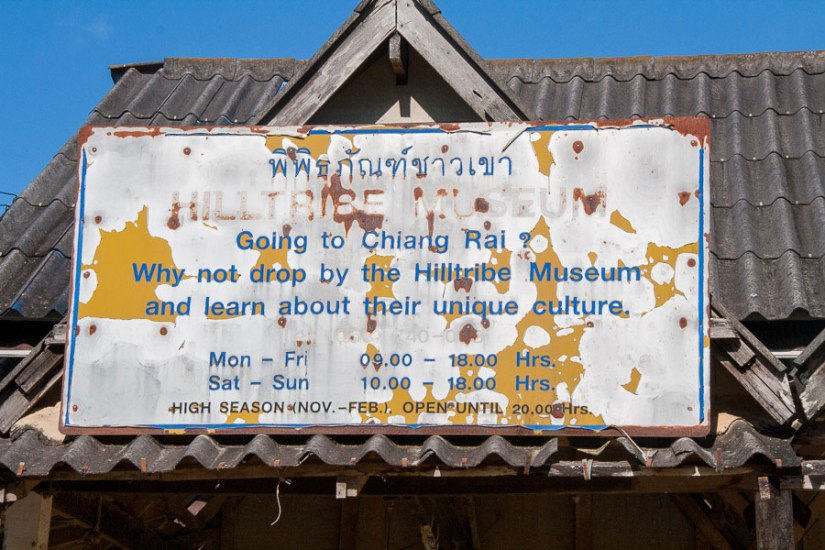
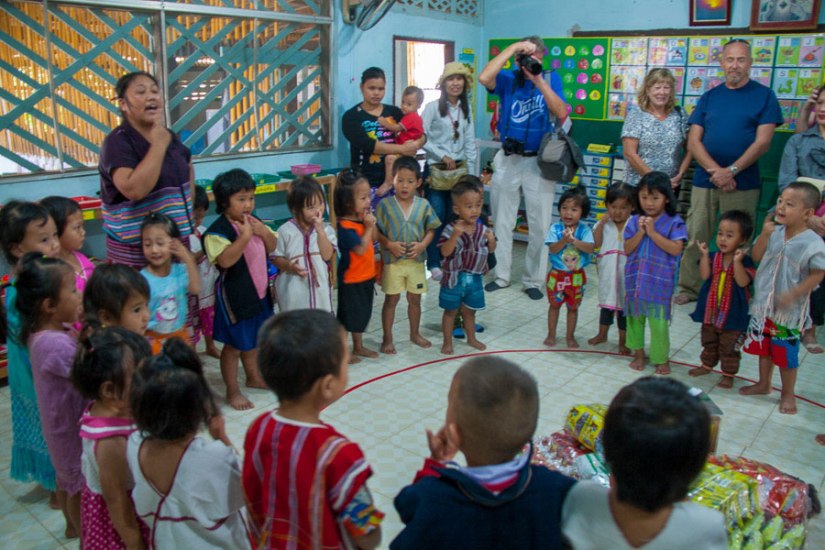
As part of World Spree’s “local connections program” we briefly visited a tiny hill tribe village outside of Chiang Rai spending most of the time at a preschool that was clearly in need of the support we indirectly provided. Cultural tourism has become an increasing source of income for the hill tribes. The village itself offered little in the way of attractions or shopping opportunity- the usual source of tourism revenue – but one enterprising woman donned traditional (Akha, I think) dress to pose for photographs and earn a few baht from the visitors. Click on an image to expand it.


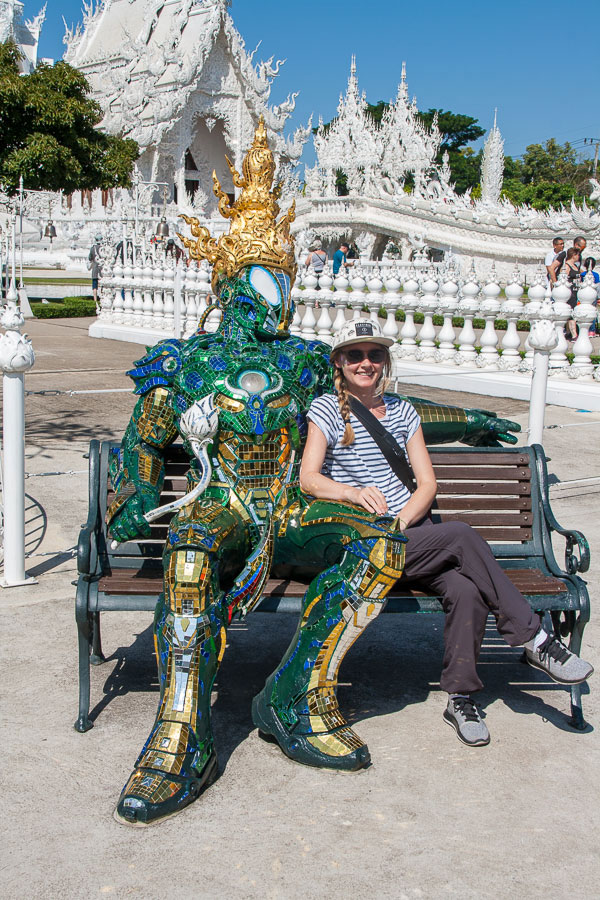
At the other end of the spectrum is Wat Rhon Khun which Wikipidea describes as ” a privately owned art exhibit in the style of a Buddhist temple.” Popularly known as The White Temple it is a fascinating collection of modern Thai Buddhist architecture and art, the life long project of a wealthy Chiang Rai artist, but it is not clear whether it is a monument to Buddha or to the artist.
The Emerald Buddha
Thailand is about 95% Buddhist and there are many statues of the Buddha throughout the country: large and small, ancient and modern, simple and elaborate, private and public. Only one, however, is considered to be the sacred palladium of Thailand, a potent religious symbol that gives legitimacy to the king and protection to the nation. It is a relatively small (19” wide x 24″ high) statue of the meditating Buddha seated in the half lotus position, made of a semi-precious stone, perhaps jasper or jade.
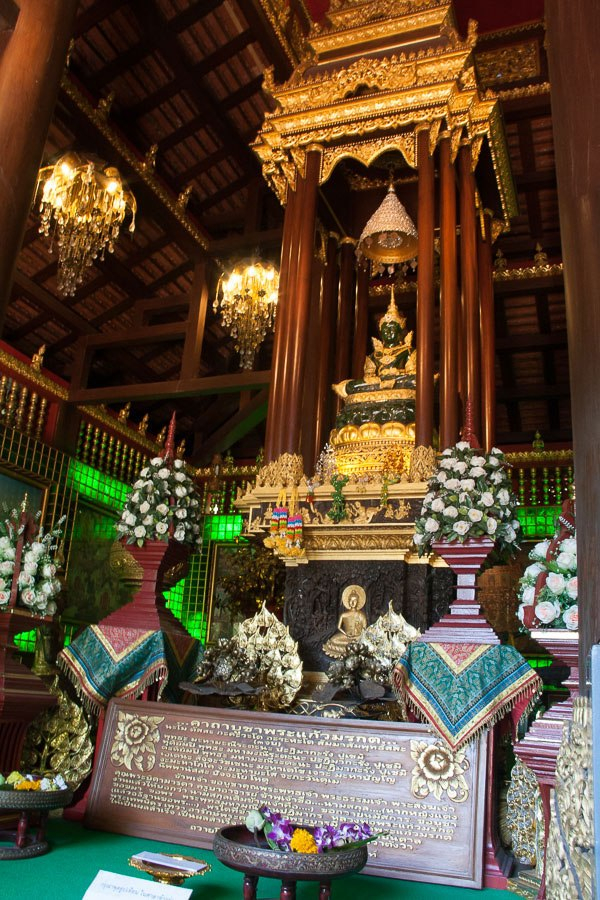
The older a Buddha image is the more power it is believed to have. The Chronicle of the Emerald Buddha is a text that traces the mythology and fabled travels of the image from the beginning of the common era, but its emergence as a historical reality is dated 1434. After lightening destroyed the chedi (stupa) of a temple in Chiang Rai a Buddha statue was found among the ruins. An ordinary looking Buddha covered in stucco, it was placed in the temple along with many other such statues. Some months later the head monk noticed that under the chipped stucco was a brilliant green color and ordered the stucco to be chipped away from the entire statue. It was seen to be made of one solid piece of green crystal without marks or imperfection. The Buddha quickly became an object of devote veneration and was coveted by kings, moved from one capital to another as their fortunes rose and fell, warring with each other and neighboring kingdoms. It was taken to Bangkok by the first king of the current Chakri Dynasty, Rama I, in 1784 who built a temple to house it on the site of the Grand Palace. It still resides there, in Wat Phra Kaew, where it continues to serve as a significant religious-political symbol legitimizing the power of the king, its caretaker.
I did not see the authentic Emerald Buddha but a replica residing in Wat Phra Kaew, Chiang Rai, where the original image was found. (The name of the temple was changed from Wat Pa Yah, meaning bamboo forest temple, when the Buddha was discovered.) The copy, which is very close but not an exact replica of the original, was carved from Canadian jade in China and installed in 1991 in honor of the 90th birthday of the Princess Mother. The name of the new image translates to Chiang Rai Jade Buddha.
More images from Chiang Rai and the White Temple here.




 Jconcetta's Journeys