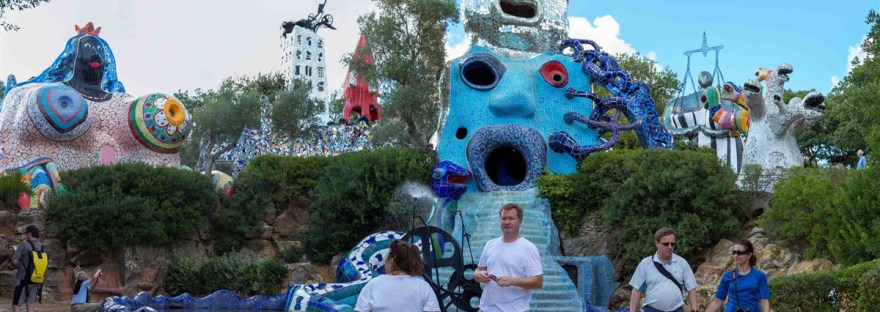
Deep in the lush south Tuscan countryside on a small mountain top not far from the Tyrrehenian Sea seekers will find a magical garden of huge sculptures inspired by the Tarot and encrusted with psychedelically colored mosaics and glass. This is the fabulous Giardino dei Tarocchi created over a fifteen year period by the French-American artist Niki de Saint Phalle who set out, among other objectives, to demonstrate that “a woman can work on a monumental scale.”

I had read about the Tarot Garden in one of those “hidden Tuscany” articles travel publications often feature and was keen to see it. Fortunately Marzia was also interested and we took off once again south, to the sea. Of course a meal was required and the tiny village in the vicinity of the Garden did not look promising. The one apparent restaurant looked pretty run down to our American eyes and on our own we’d have probably gone hungry. Marzia to the rescue! After huddling with the proprietor she lead us out to the table on the front porch where we were served, family style, a sumptuous fresh seafood feast: mussels appetizer followed by pasta with clams in the shells, then calamari and a green salad with a macchiato to keep us awake for the Garden.
We didn’t really need the macchiato as the Tarot Garden is so exuberant, so colorful, so full of life and joy that I can hardly imagine ever going to sleep there. Yet sleep there Niki did, living part of the time during the long construction period inside the mammoth sculpture of The Empress, the first built of 22 enormous sculptures representing the Major Arcana of the Esoteric Tarot.
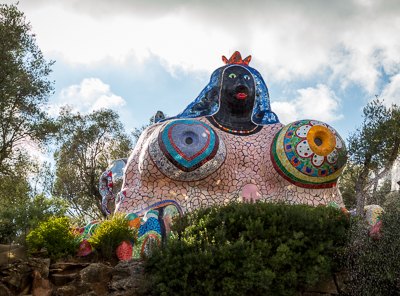
The Empress 
Inside the Empress 
Niki’s bedroom was in the right breast of the Empress, her kitchen in the left. 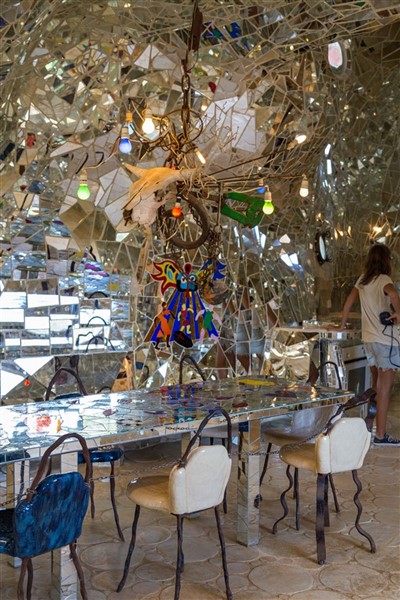
Dining room table where Niki served lunch to the workers 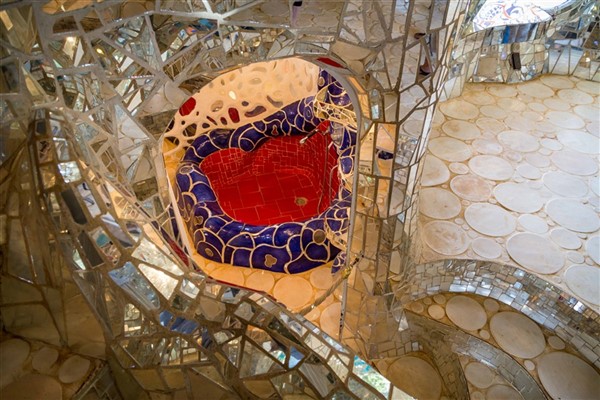
The Jacuzzi
The Artist
Niki de Saint Phalle (1930-2002) was born in France into an aristocratic family whose financial misfortunes led them to immigrate to America, settling in New York City when she was three years old. Both parents, he a banker and she a fanatically strict American Catholic, were temperamental and violent and Nike described her home life as hell. Two of her siblings committed suicide as adults. She continuously rebelled, was thrown out of several schools as a teenager. A wispy, blue-eyed beauty, Niki was modeling at age 18, appearing on the covers of Vogue and Life. She married not long afterward and bore two children. The role of wife and mother assigned to her by society (not to mention years of sexual abuse by her father starting at age 11), was anathema to her, so much so that she ended up in a psychiatric hospital in Nice for six weeks. There she was encouraged to take up painting and other hands on artistic projects and discovered not only their healing qualities but an outlet for her contrariness, her fearlessness, her unquenchable life force, an outlet that defined the trajectory of her life. She later remarked “My mental breakdown was good in the long run because I left the clinic a painter.”
It is almost impossible to succinctly describe Niki’s prolific and turbulent artistic career after, in 1960, she finally gave up the obligations of everyday family life to create art full time. Self-taught, working outside mainstream art institutions (indeed, thumbing her nose at the art, religious and political establishments), constantly experimenting with new styles, techniques and materials, she soon found cohorts in the avant-garde French New Realists; she was the only female member.
Her earliest works, which she called Tirs (shootings), were aggressive, violent expressions of rage which attracted media attention and gained her notoriety in Europe. Large boards were covered with plaster in which was embedded bags and/or spray cans of multicolored oil paints, razors, baby doll limbs, crockery and other household detritus. Niki would then, in a staged public event, shoot at the assemblage repeatedly with a rifle or pistol, causing it to “bleed,” creating through destruction, combining performance, body art, sculpture and painting. These “happenings” expanded to art galleries, museums, private functions in Europe and the United States where other artists and even the public were invited to shoot at the assemblages. Participating in an unusual program of multiple, transformable artwork editions, Niki created a limited number of Tirs assemblages for purchase including detailed instructions for how to shoot them with a .22 rifle. A fascinating analysis of this work in the context of art at that time and the personal significance for Niki can be found in a publication of the Walker Art Center.
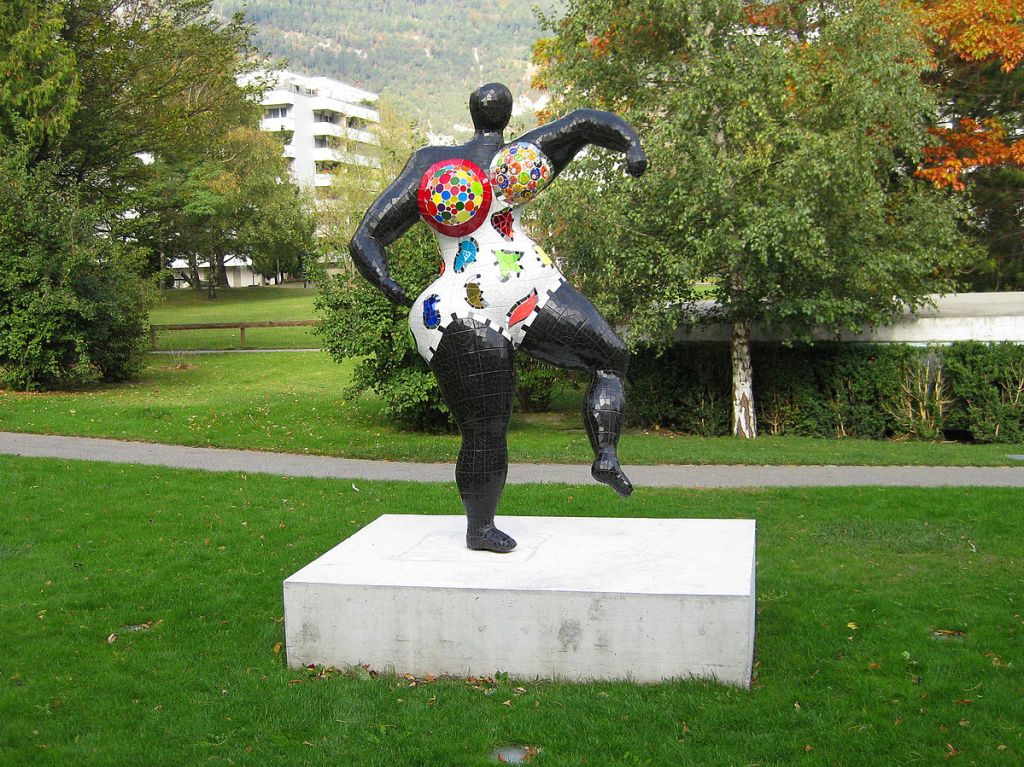
The Tirs period lasted only a couple of years after which Niki turned her attention to protesting the stereotypical roles of women in society by creating life size sculptures of brides, whores, monsters, mostly in soft materials. These evolved into her best known and most prolific sculptures, which she called Nanas , a French slang word meaning, roughly, “babe” or “chick”. Working with fiberglass reiforced polyester resin and gloss painting techniques, Niki was able to create monumental pieces that could be outdoors in all weather. Larger than life, voluptuously exuberant, intensely colorful, the Nanas reflect a more optimistic view, projecting indomitable feminine energy: “From provocation I moved into a more interior, feminine world.” These sculptures were exhibited widely in Europe at the time and public installations ( art “without intermediaries, without museums, without galleries”) still exist there, in Israel and California.
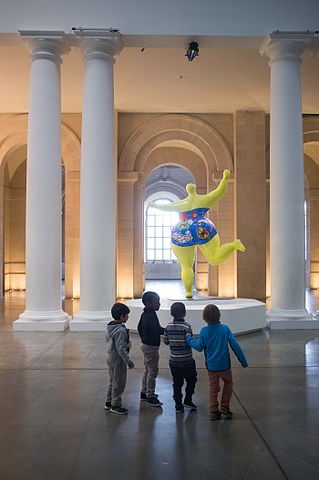
Niki’s work was classified as Outsider Art, a term for those who had a self-taught style, lying outside the defined “norm.” Her work was often dismissed, especially by American critics. Today she is receiving long overdue attention and appreciation.
The Tarot Garden
Although Niki continued to create Nanas for the rest of her life, successfully commercializing them in different media in the face of sniffing disapproval from the art establishment, in the early 1970’s she turned her attention and energy to a long held dream: the creation of a mystical, magical sculpture garden of joy, a monumental expression of her own spiritual universe. The dream dated back to 1955 when she was awestruck by the flowing organic forms, diverse material usage and vibrant colorful mosaics of Antoni Gaudi in Barcelona. His use of shapes found in the natural world to create a dialogue between sculpture and nature spoke to a deep naturalism in her which rose to the fore years later.
With an introduction from their sister, a friend of Niki’s from her modeling days, two wealthy Italian brothers were won over by Niki’s charm and enthusiasm for the project and gave her a sizeable chunk of land, 14 acres atop an Etruscan ruin by the sea. Thus began a 15 years saga of difficult and intensive work, from creating the colossal sculptures to finding financial support to winning over local skeptics to coping with debilitating illness. Here are Niki’s own descriptions of the process. If you go to the cited article you will see that her purpose was to credit all the people – and there were many from all over the world – who worked with her to create this astonishing place. I have left out the names to focus on the process.
…All of the monumental sculptures armatures were made from welded steel bars, formed by brute strength on the knees of the crew….
Once the steel armatures were finished and the wire mesh was stretched over them, they were ready for gunite cement which was sprayed on. The sculptures then had a melancholy look with a certain sad beauty. My purpose, however, was to make a garden of joy. The finishing of the cement was later done by hand…
The twentieth century was forgotten. We were working Egyptian style. The ceramics were molded, in most cases, right on the sculptures, numbered, taken off, carried to the ovens, cooked and glazed, and then put back in place on the sculptures. When ceramics are cooked there is a 10% loss in size, so the resulting empty space around the ceramics were filled in with hand cut pieces of glass…
The smaller pieces in the garden were made by me in Paris, France…then fabricated in polyester…later covered in glass mosaics from Murano, Czechoslovakia and France…
I have chosen to respect the natural habitat of the region. The dialogue between nature and the sculptures is a very important part of the garden…
Niki de Saint Phalle
The Tarot Garden was formally opened to the public in 1998; by then Niki had moved to La Jolla, CA, because of declining heath. Despite handicaps she continued to explore new techniques, new media and became an active member of the San Diego art scene. She also continued to design additions for the Tarot Garden, including a wall and entrance way to clearly delineate the garden (“…a place to dream.”) from the outside world. In 2002 she died of respiratory failure, attributed to the years of inhalation of fiberglass and toxic fumes from her art making processes. As previously specified, all new work in the Tarot Garden was halted and the focus now is on preservation and conservation.
The Sculptures of the Tarot Garden
Rather than a post, I have chosen to make a Travel Gallery page showing the sculptures I photographed in the Tarot Garden. Please go there to see these magical figures and for more information about the individual representations of the cards. Notice that there are (sometimes hard to see) links in several of the image captions. Many are from a site devoted to mosaics and contain interesting descriptions of the symbolism of the pieces.
Further Reading
With renewed interest in her work, especially as it has been re-examined in light of the 1994 publication Mon Secret revealing her childhood sexual abuse, many articles have been written about Niki de Saint Phalle. Here are some I found to be particularly insightful. All of the references below were accessible as of 09/25/2021.
- Ariel Levy, Beautiful Monsters: Art and Obsession in Tuscany, The New Yorker, published in the print edition of April 11, 2016
- Andy Robb, Niki de Saint Phalle: A Personal Journey in the Public Eye, Xamou, August 4, 2015
- Isabella Davey, My Art My Dreams: Into the mystic of the tarot with Niki de Saint Phalle, The Ingenue
- Johanna Sluiter, Niki de Saint Phalle’s Vibrant, Multidimensional Universe, HYPERALLERGIC, April 11, 2021
- Caroline Galambosova, The Colorful and Extraordinary World of Niki de Saint Phalle’s Tarot Garden, Daily Art Magazine, January 26, 2021
- Peter Schjeldahl, The Pioneering Feminism of Niki de Saint Phalle, The New Yorker, published in the print edition of April 5, 2021 with the headline “Life Force.”


 Jconcetta's Journeys
