
Most people, when they think Tuscany, think Florence and maybe San Gimignano with its 14 intact ancient towers. Siena, if considered at all, is an afterthought, maybe worth a day. What they are missing! As Rick Steves has so eloquently pointed out, Siena’s eventual political and economic irrelevance has preserved its Medieval identity, to our gain. It wasn’t always so, the irrelevance, i.e.
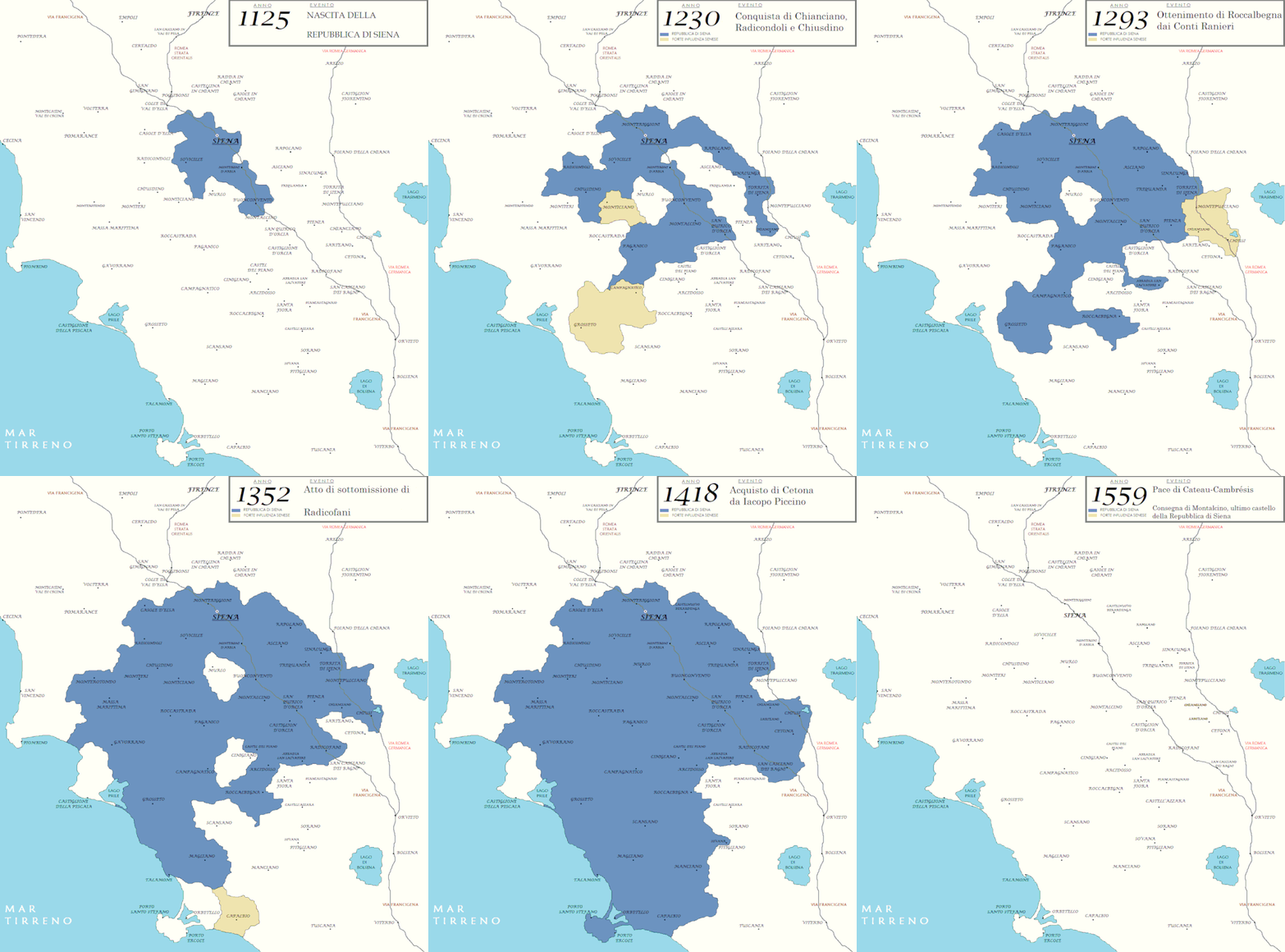
From the early 12th C. to the mid 16th C. the Republic of Siena, consisting of the city and its surrounding territory, was one of the powerful warring city states of the Northern Italian peninsula, in a class with Milan, Venice, Florence, Genoa. It rivaled Florence in the arts and financial prowess during the 13th and 14th centuries. Devastated, like much of Europe, by famine and the Black Death, it was finally defeated by the Republic of Florence and remained under its rule, a backwater, until Italian unification in the mid19th C.
Even today the Senese* will tell you they feel treated like 2nd class citizens when it comes to political pork, but they are a proud and resilient people, valuing real pork more, living the good life. One aspect of that good life is the relative lack of vehicles within the walls of the city. Neither cars nor bicycles, with a few authorized exceptions, are allowed within the city walls, the restriction being policed by 24 hour cameras with heavy fines for transgressors.
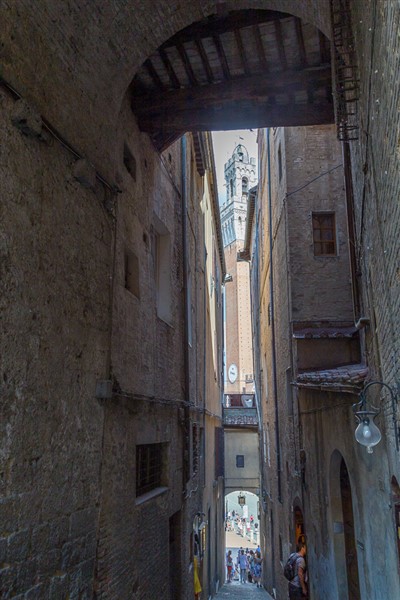
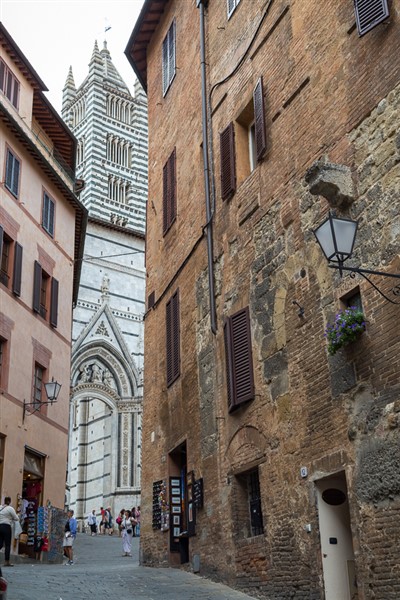
Having locals for friends and guides meant we knew which porto to enter for a given destination, where to find parking (sometime free parking!) and how to use the parking meters, any one of which might have defeated us otherwise. Once the car was sequestered we roamed within the walls, up and down steep, narrow streets flanked by tall Medieval buildings bedecked with flags of the contrade. Small or large open spaces appeared associated with important edifices like Gothic palaces or ancient churches and, of course, the Duomo and the Piazza del Campo. A bit about each of these unique Senese phenomena follows in subsequent posts and their accompanying pages.
*I have retained the Italian spelling for some key words and render them in italics.
The Contrade of Siena
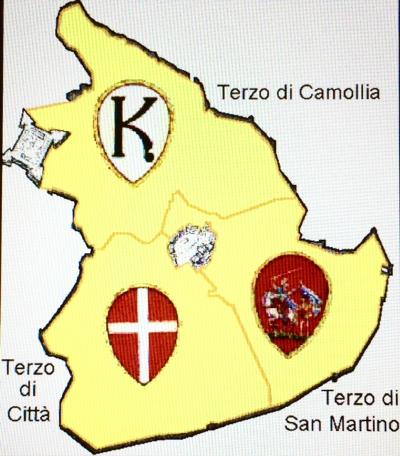
Siena is divided into three main parts each of which are further divided into contrade. Contrada in Italian means district or ward but these are much more than simply neighborhoods. They are a way of life: different populations in different states, held together by their histories and civic pride. In the Middle Ages Siena was said to have been divided into 59 contrade whose main purposes were to supply soldiers for mercenary armies and provide a mechanism to collect taxes.
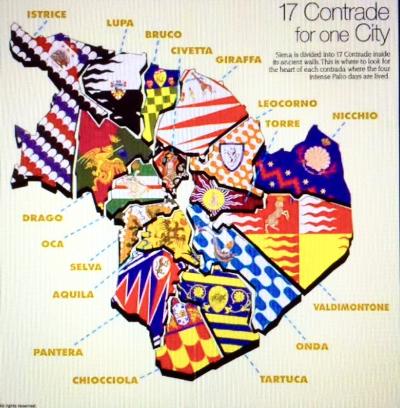
Over time the number and functions of the contrade have changed. There are now, and have been for about 300 years, 17 contrade di Siena, each having their own coat of arms, delimited territories, statutes, population, patron saint, museums, festivals, official representatives, church, baptismal fountain, motto, songs, allied contrada and adversary contrada. Every important event – baptisms, marriages, deaths, church holidays, wine festivals – are celebrated only within one’s own contrada. Loyalties are fierce and competition even fiercer, especially for the twice yearly run bareback horse race called the Palio.
More about the contrade and, in particular Bruco, which we visited, here.
 Jconcetta's Journeys